
The Employee Merit Cycle (EMC) Workbook for FY28 will open on February 1, 2027
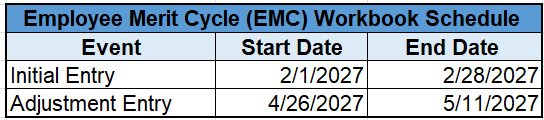
Operating within the Employee Merit Cycle (EMC) Workbook
- Employees hired until March 1, 2027, will appear in the EMC Workbook only if a Workforce Compensation Manager (WCM) is assigned in iO; however, they are not eligible for merit increases due to their six-month probationary period, and should not receive any salary adjustments or bonuses. The WCM is responsible for verifying that new hires in a probationary period are excluded from the employee merit cycle.
- The Employee Merit Cycle Workbook will refresh Assignment titles, Grades, and Salaries nightly.
- Please note: If you remove the Workforce Compensation Manager from the employee’s assignment, they will be removed from your workbook overnight during the workbook refreshes.
Transferring Data to Human Resources
- The proposed base salary is what will be entered as a salary change on 07/01/2027.
- IMPORTANT: To ensure the employee merit cycle workbook successfully loads salary records or bonuses, avoid submitting or processing compensation change actions during the last week of June.
- If an employee’s assignment has an end date on their existing salary record (other than 12/31/4712) the Employee Merit Cycle Workbook will not load an entry effective 07/01/2027.
Options are:
Either remove the end date from the salary record via Salary History or Change Salary
Or
Add 07/01/2027 record via Salary History or Change Salary.
- Error reports will be shared with the Workforce Compensation Manager in June for review and to take action on salary actions or promotions that did not load.
Annual Merit Increase Process
Merit Increases
- The annual merit increase process is not a cost-of-living adjustment, but rather an opportunity to recognize the performance and contributions of your staff.
- Merit increases are based on performance, and the pay raise pool is determined each year by University leadership.
- The pay raise pool is determined by considering market trends, University financial resources, and overall University strategy and goal achievement.
- Merit increases are effective July 1st of each year.
- Merit increases outside of the July 1st merit increase cycle require the approval of a Vice President, Vice Provost, Dean, or the Provost (or their designee).
***Staff promotions proposed for July 1, 2027, require that all required documents be submitted to compensation@rice.edu for review no later than April 30, 2027. Promotions submitted after the EMC workbook closes will be reviewed and processed in accordance with normal promotion procedures.
- Annual salary adjustments should be based on performance and not made across-the-board increases
- Staff fully supported by research grants, gift funds, or other sources should follow these guidelines as well.
- IMPORTANT: For new staff, the first six (6) months of employment at Rice University are the probationary period. Current staff who apply for and are promoted, demoted, or transferred to a different position also must complete a six (6) month probationary period. Probationary Period Policy
- Please see detailed Salary Administration guidelines from the Budget Office for FY28 as well as the FY 2027 Annual Budget Information.
- Departments and supervisors should communicate the upcoming compensation with each employee. It is recommended that you also generate a letter with this information - here is a link to the sample FY28 merit cycle letters. You can also upload the final letter to each employee's iO document records.
- The compensation team is available to provide additional advice about rewarding performance and making the best use of available dollars for base adjustments and bonuses. Please contact the HR compensation staff to discuss staff salary planning and one-time payments. The compensation team will review all staff salaries for consistency with Rice’s compensation practices and with performance assessments.
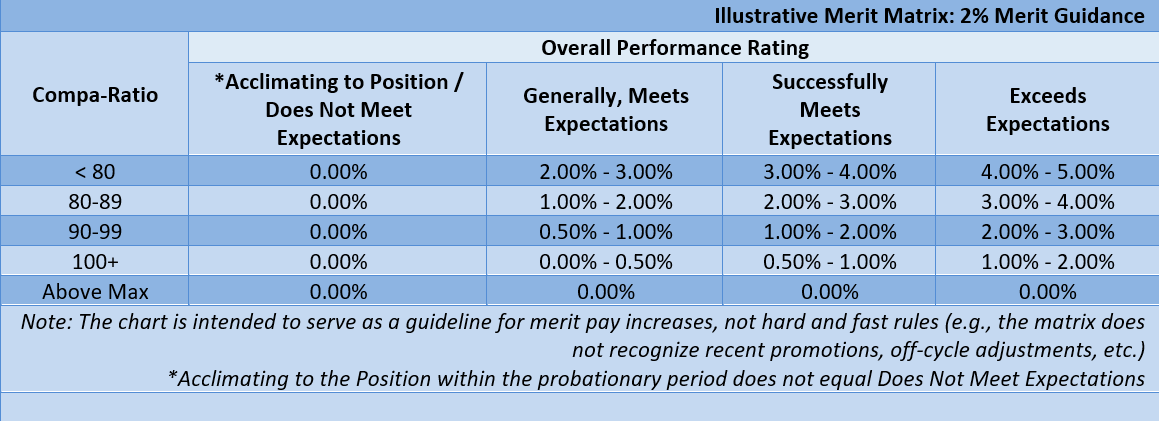
Merit-Based One-Time Payments and Bonuses
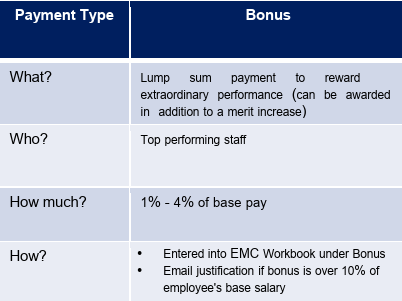
During the annual merit process, bonuses may be used in the following ways:
- Bonuses (one-time payments) may be provided to employees in lieu of a base pay increase. This is commonly used for employees whose current annualized salary exceeds the maximum for their position’s pay grade.
- Bonuses are also used to reward extraordinary performance and/or contributions of employees during the year.
- The following chart provides guidance on determining whether a bonus is appropriate for a given situation.
Resources:
- Compensate Workers in EMC Job Aid: Covers how to navigate the employee merit cycle workbook and apply salary adjustments, performance bonuses, and/or promotions that occur at the beginning of the fiscal year.
- How to Change Workforce Compensation Manger: This job aid will show how to process a Workforce Compensation Manager change in Oracle.
- Add or Reassign Workforce Compensation Manager in iO - This guide can be used when reassigning one or all existing reports as a result of a Workforce Compensation Manager change.
- How to View Your Total Compensation Statement in iO - Use this guide to view your total compensation statement in iO, which helps you better understand your Rice Total Rewards package
- Performances Resources: Performance Management
- How to access Merit Salary Letters (Annual Compensation Change Statements) in iO: Guide to access merit salary letters in iO
- FY27 Staff Salary Letters: Merit Increase, One-Time Pay/Bonus In Lieu of Merit Increase, Over the Max – One-Time Payment in Lieu of Merit Increase, No Increase Due to Performance Templates